

The People on the Bus Go Mumble Mumble Mumble
June 16, 2004 by Ryan · Leave a Comment
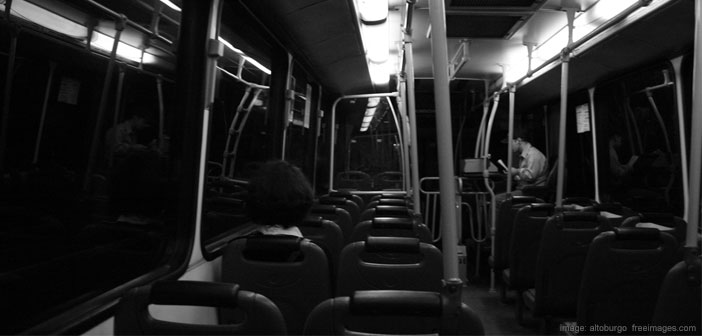
Being one of the members of the seeming marginal demographic known as public transport commuters - and of the even marginal-marginal demographic of occasion enjoyers of public transport - it’s no wonder that I’ve made some observations on my journeys. Well, not as much observations as major peeves.
1) Stop Here on Red - This is for all the privileged classes out there, the ones with their own transport. When you see a sign saying “Stop Here on Red” and there is a bright white line emblazoned on the street… STOP THERE ON RED. What, you think the D.O.T. had too much paint and sheet metal on their hands? It’s so big busses can maneuver on streets built back when a full fuel tank was nothing more than a bucket of oats.
It did take me a while to figure it out, the sign, but when the busses started crushing over-important BMWs… ding!
2) Move to the Back of the Bus - One day as I rode home from work, I overheard a black man standing next to me telling his daughter “thanks to a little old lady, we no longer have to go to the back of the bus.” Now I thought that was a nice little civil rights lesson… but it’s really not helping the fact your standing on my foot!
One of the great phenomena of bus riding is Bus Rider Viscosity, or BRV. This is when one rider (a) gets on a bus, and sees another he/she knows (b) and stands next to that person (ab). This then forces the rider behind rider “a” (c) to stand next to “ab” (abc). And so on. Thus this causes a back up in the forward section of the bus, leaving a spacious nirvana towards the back. BRV is usually the result of the overpopulation of freakin’ brain-dead middleschoolers, but is in no way limited to them..
Now this obviously leads to the precarious situation known as “Pardon me,” or as most of the obstructions hear it: “…”. It isn’t fun wading though a sea of teens with their cooler than thou attitudes and potential box cutters.
It’s even less fun when just as you reach the nirvana of the back, the driver pulls the “Shakin’ Break.” This happens when most to the strap-hangers flex their weary fingers in unison for a split second, and the driver slams on the breaks for no apparent reason. You’ve never seen dominoes till you been in one of these.
I don’t suppose everyone could just thin themselves out, yes? You know, keep the spirit of the center aisle alive?
In both cases, there is a simple solution.
A Bunch of Sonnets
June 16, 2004 by Ryan · Comments Off
A bunch of Sonnets
by Ryan Livingston
Sonnet #Something-Or-Other
How’s this for a kick in the pants:
For two months now
I’ve waited for the chance
To introduce myself
To a woman I’ve seen.
Two months?
Is that how long its been?
Yes, I’m afraid so.
And look at the waste of time it was.
Because I got the opportunity
And after an awkward pause
I find she was a louse.
She was on enough cocaine
To kill a house.
Sonnet #279,486,430… etc.
Pardon me madam,
Did I say something wrong?
Are we on the same page,
The same chord of the song?
What could I do,
I was nervous that night.
I fumbled for words
But they didn’t come out right.
You took it the wrong way,
The opposite of was meant.
As for me,
Sleepless nights were spent.
And now I know not what to do,
Because, madam, I still love you.
This was first published on www.poetry.com.
Sonnet #3
A bitter man sits in his chair.
He screams and he raves
And he pulls out his hair.
Why he behaves
This way is not known.
A car wreck? A stroke?
The game that was blown?
None of these the doctor spoke.
He’s twenty, without a friend on this sphere.
Fate is against him, his plans are dashed.
His mind is full of confusion and fear.
To put it simply, his will is smashed.
And you dare ask what the problem is?
If you were he, you’d have depression like his.
Sonnet #4
I see a field
It cannot hide.
The blades of grass
And petals bide.
It cannot move,
Nor drift away.
It’s good to know
It’s here to stay.
What else is there
That’s good to see?
Amongst it all
Beneath a tree…
You are the one
When said and done.
This was first published in The Pavan, the St. Peter’s College literarry journal.


